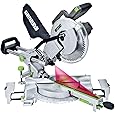
Delta 10 Sliding Compound Miter Saw 26-2241
Category: Miter Saws
Delta 10 ” Sliding Compound Miter Saw 26-2241 excels in small workshops with compact precision. The 10-inch blade and sliding rail preserve bench space while expanding cut length. This tool sits squarely among Miter Saws ideal for compact hobby shops.
Why Delta 26-2241 Excels in Small Workshop Layouts
Delta 10 ” Sliding Compound Miter Saw 26-2241 fits tight benches by combining a short overall depth and sliding rails that extend crosscut capacity. The saw’s 29.5″ depth and 22.5″ width keep floor and benchtop footprint low, which helps small-shop layout planning. Miter Saws for compact spaces must balance cut capacity and reachable controls; this model places the miter and bevel controls on the front for easier access. The front-mounted controls and one-hand miter control reduce the need to walk around the tool, which speeds workflow in cramped workshops.
- Blade diameter: 10″
- Motor: 120V, 15 A
- No-load speed: 4,000 RPM
- Cutting capacity: nominal 16″ cross-cut, max thickness 5.5″
- Bevel: dual 45 left/right, 7 stops
- Miter: 50 left / 60 right, 10 detents
- Weight: 55 lbs.; dimensions: 29.5 D x 22.5 W x 20 H
How does blade diameter and bevel range affect accuracy?
10-inch blade improves stability and produces straighter cuts on common stock sizes used for enclosures. Blade diameter (the blade’s cutting circle) affects how close you can cut to fences and how much motor torque the blade demands, and a 10″ blade requires less clearance than a 12″ blade. Bevel range (the saw head tilt) defines the angles you can cut without flipping workpieces; dual 45 bevels let you cut compound angles for speaker baffle bevels and trim. For a first-time speaker builder, choose a 60-tooth finish blade for clean plywood edges and use the saw’s dual-bevel to cut recessed baffle angles without rotating the box, which saves time and preserves alignment.
Optimizing small workshop workflow with a compact miter saw
Delta 26-2241 places control ergonomics and repeatability where small-shop operators need them most by offering front-access miter and bevel controls and a shadow guide cutting line. The shadow guide projects a consistent cutting line that speeds alignment for repeated cuts and reduces time spent marking. Sliding action increases crosscut capacity without a larger footprint, so you can cut 2×12 stock that often appears in speaker stands and outdoor enclosure frames. The saw’s molded handle and full-size trigger support both right- and left-handed users, improving comfort during higher-volume projects.
What can I expect for dust collection efficiency in tight shops?
The dust port captures a significant portion of chips and reduces airborne fine dust near the cutting zone. The saw includes a standard collection port that works best when paired with a 2.5″ to 35mm shop-vac hose to maintain suction close to the blade. In small workshops, use a rated shop vac with a HEPA or fine filter to protect lungs and speaker components from dust; a two-stage cyclone pre-separator further reduces vacuum filter clogging. Expect 60-80 large-chip capture with a standard port, and improve that to 85-95 by adding a sealed dust bag or a dedicated 1.5-2.0 kPa-rated dust extractor at higher airflow.
Delta 26-2241 Durability and Precision for Repetitive Cuts
Delta Miter Saw 26-2241 builds repeatability into its hardware through indexed detents, a front bevel release, and a robust 15 A motor that handles plywood and hardwood used for speaker cabinets. The 10″ sliding system and the blade brake contribute to safer, quicker cycle times when you run batches of identical parts. Repetitive cut setups benefit from the push-button detent override and lever override between stops, which let you micro-adjust angles without losing the original detent positions. For durability, the molded handle and full-size trigger reduce user fatigue and the cast base resists twist when clamping jigs or fences.
- Blade brake: yes (reduces spin-down time and improves shop safety)
- Front bevel release: yes (simplifies angle changes)
- Miter detents: 10 with push-button override (for repeatability)
- Bevel stops: 7 (common angles locked for production)
- Power: 120V, 15 A corded AC motor (recommended dedicated 15 A circuit)
Which accessories improve small-shop repeatable cuts best?
A stop block and clamping fence ensure identical part lengths and reduce repositioning error. Add a sacrificial fence for zero-clearance cuts when you need edge-finish fidelity, and use a Kreg or Rockler crosscut sled to square repetitive cuts without rotating material. A 60-tooth carbide blade yields cleaner edges on plywood speaker panels, while a 40-tooth blade speeds rough framing cuts with acceptable finish. Brands and accessories that pair well include Kreg stop-blocks, Rockler featherboards, and Bora outfeed supports; these items improve repeatability and safety for enclosure fabrication.
Follow-up questions buyers search next
How long will the motor last under hobby use? Under normal hobby use the 15 A motor typically lasts many years; life depends on duty cycle, maintenance, and dust control. Frequent heavy cuts under poor dust extraction shorten bearing life, so maintain a clean workspace and change brushes per the manufacturer’s schedule. For heavy production, consider periodic professional service to preserve power and alignment.
What blade tooth count suits speaker cabinet plywood? Choose a 60-tooth or higher blade for cabinet veneers and exterior-grade plywood to produce smooth edges with minimal tear-out. Use a 40-tooth blade for internal framing and bracing where finish quality matters less. Always test cuts on scrap and adjust feed speed and blade choice to balance finish and cut time.
Questions you might search next: Can I build outdoor speaker enclosures with this saw? What blade guard modifications are safe for custom jigs? How do I tune fence alignment for perfect 90 corners? Each of these requires specific setups, recommended blades, and dust-control measures covered above and in the saw’s manual.