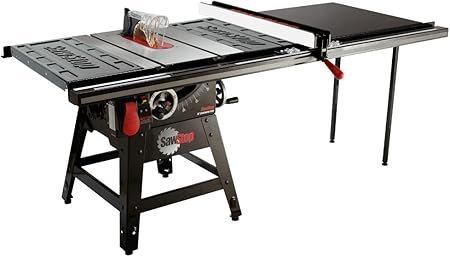
SAWSTOP CNS175-TGP52 10-Inch Contractor Table Saw
Category: Table Saws
Yes the SAWSTOP CNS175-TGP52 likely is the best contractor saw for safety-focused shops. It uses SAWSTOP flesh-detection (electrical skin-sense) that stops the blade under 5 ms. This model redefines safety in Table Saws for professional and serious hobby shops.
SAWSTOP CNS175-TGP52 safety features for pro shops
SAWSTOP CNS175-TGP52 10-Inch Contractor Table Saw brings integrated flesh-detection and precise alignment for professional shops. SAWSTOP CNS175-TGP52 pairs a control box and T-Glide fence for repeatable, safe cuts across Table Saws. SAWSTOP 10-Inch Contractor Table Saw features poly V-ribbed belts and a rigid trunnion arbor to hold zero and reduce vibration. CNS175-TGP52 reduces kickback risk and improves operator confidence during frequent production work.
- Blade: 10-inch
- Motor: 1.75-HP
- Safety: patented flesh-detection stops blade in <5 ms
- Fence: 52-inch T-Glide heavy-gauge steel
- Table flatness: 0.010 in diagonal max gap
How does the flesh-detecting blade brake trigger and react?
SAWSTOP CNS175-TGP52 triggers the patented brake and halts the blade in under five milliseconds. A low-voltage electrical sensor senses skin contact by conductivity change, flagging the onboard computer. The system activates a spring brake that severs the carbide brake cartridge and drops the blade. Operators retain full fingers and avoid major surgeries in most touch incidents.
Optimizing shop layout, dust management, and cut workflow safety
SAWSTOP CNS175-TGP52 10-Inch Contractor Table Saw requires clear infeed and outfeed space for safe, efficient workflows. SAWSTOP CNS175-TGP52 recommends minimum 6 feet infeed, 8 feet outfeed for handling sheet goods. This arrangement pairs well with a 6-inch main duct and 4-inch drops to the saw for dust control. Install blade guards, splitter, and push sticks within reach to sustain safe cut sequences.
How should I size a dust collector for heavy shop use?
A 2-3 HP dust collector delivers 1,000-1,500 CFM (cubic feet per minute) suitable for heavy small-shop use. Sum each tool’s CFM, then apply simultaneity factor 0.6-0.8 (fraction used together). For example, assume a table saw needs about 400 CFM and a planer 1,200 CFM; choose roughly a 1,600 CFM system for simultaneous use. Prefer cyclone separators, short runs, 6-inch trunking, and blast gates to minimize static pressure (airflow resistance).
SAWSTOP CNS175-TGP52 maintenance, upgrades, and blade options
SAWSTOP CNS175-TGP52 10-Inch Contractor Table Saw demands regular calibration, blade maintenance, and occasional cartridge replacement. CNS175-TGP52 uses a control box with continuous self-checks, which simplifies diagnostics and troubleshooting for busy shops. You can add the CNS-CIWA cast iron wing assembly for heavier support and larger work surface when cutting panels. Follow torque specs, keep belts tensioned, and check table flatness periodically for consistent, accurate cuts.
What is the expected ROI for safety investments in a small shop?
CNS175-TGP52 reduces severe injury risk and lowers potential liability costs for small shops. At $2,600 list price, a single prevented amputation often saves well over $100,000 in medical and legal costs. Plan maintenance costs: brake cartridge replacement after activation and regular blades like 24T rip and 80T crosscut. Will insurance premiums drop? Possibly; consult your insurer for shop-specific premium reductions. How quickly is ROI achieved? Preventing one severe injury within three years often yields positive ROI.