Miter saws, sliding miter saws, and compound miter saws solve shed and deck framing by making 2x lumber crosscuts, bevel cuts, and repeatable angle cuts on site. The Metabo HPT C10FCG leads this use case with a 15-amp motor and a 2 x 6 crosscut capacity at 90 . Save time by checking the Comparison Grid below first, then skip the read if you want prices fast.
Metabo HPT 10-inch compound miter saw
Compound miter saw

Cutting 2x Lumber: ★★★★☆ (10-inch blade, 5,000 RPM)
Jobsite Portability: ★★★★☆ (24.2 lbs)
Setup Without Stand: ★★★★☆ (thumb-actuated positive stops)
Outdoor Stability: ★★★☆☆ (vice clamping system)
Angle Adjustment Ease: ★★★★☆ (0-52 miter range)
Dust Management: ★★★☆☆ (dust port not specified)
Value for Framing: ★★★★★ ($139)
Typical Metabo HPT 10-inch compound miter saw price: $139
POWERTEC portable miter saw workstation
Miter saw stand

Cutting 2x Lumber: ★★★☆☆ (workstation stand)
Jobsite Portability: ★★★★☆ (rubber wheels, 330 lbs)
Setup Without Stand: ★★☆☆☆ (stand required)
Outdoor Stability: ★★★★☆ (spring-loaded locking legs)
Angle Adjustment Ease: ★★★☆☆ (quick-release brackets)
Dust Management: ★★☆☆☆ (no dust port)
Value for Framing: ★★★☆☆ ($159.99)
Typical POWERTEC portable miter saw workstation price: $159.99
TACKLIFE miter saw stand
Miter saw stand
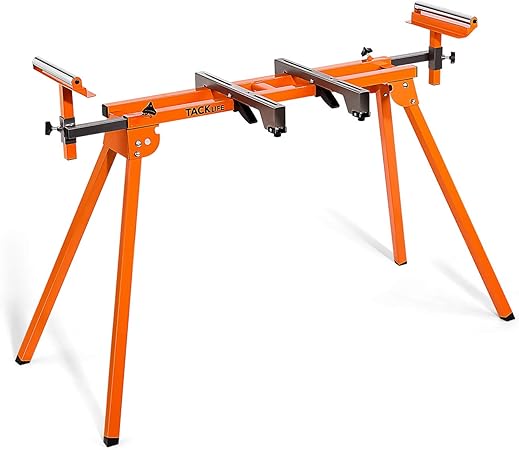
Cutting 2x Lumber: ★★★☆☆ (stand only)
Jobsite Portability: ★★★★☆ (21.6 lbs, foldable)
Setup Without Stand: ★★☆☆☆ (mounting brackets)
Outdoor Stability: ★★★★☆ (330 lbs capacity)
Angle Adjustment Ease: ★★★☆☆ (quick-release brackets)
Dust Management: ★★☆☆☆ (no dust port)
Value for Framing: ★★★★☆ ($104.97)
Typical TACKLIFE miter saw stand price: $104.97
Top 3 Products for Miter Saws Compared for Framing a Shed or Deck Without a Workshop (2026)
1. Metabo HPT Compact Framing Cut Capacity
Editors Choice Best Overall
The Metabo HPT suits buyers framing sheds or decks who need a corded miter saw with fast setup and easy carrying.
The Metabo HPT uses a 15-Amp motor, reaches 5,000 RPM, and weighs 24.2 lbs for jobsite portability.
The Metabo HPT offers positive stops and a 10-inch blade, but the 0-52 cut range limits wider crosscut demands.
2. POWERTEC Portable Saw Station Base
Runner-Up Best Performance
The POWERTEC suits users who need miter saw stand compatibility and a mobile base for outdoor jobsite use.
The POWERTEC includes 8-inch rubber wheels, 330 lbs weight capacity, and a 110V power strip for bench-top tools.
The POWERTEC adds setup speed and cord access, but the stand does not include a miter saw.
3. TACKLIFE Foldable Jobsite Stand
Best Value Price-to-Performance
The TACKLIFE suits buyers who want portable miter saw support for setup without shop infrastructure.
The TACKLIFE weighs 21.6 lbs, folds to 35.8 x 9.8 x 5.9 inches, and supports 330 lbs.
The TACKLIFE stores easily, but the compact folded design still requires a separate saw and mounting setup.
Not Sure Which Miter Saw Fits Your Shed or Deck Framing Job?
A weekend builder on a driveway needs clean 2x lumber cuts, a helper who can carry tools without a stand, and repeatable angles for rafters or deck rails. A renter working from a garage needs fast on-site setup and enough crosscut capacity to keep framing moving. A solo user on uneven dirt needs stable outdoor cutting and fewer resets between boards.
Clean 2x Lumber Crosscuts depend most on Cutting 2x Lumber. Fast On-Site Setup depends most on Setup Without Stand. Stable Outdoor Cutting depends most on Outdoor Stability, while Accurate Angle Repeats depend most on Angle Adjustment Ease.
The shortlist covers those buyer types with the Metabo HPT, POWERTEC, and TACKLIFE. The lowest price starts near $129.00, and the highest price lands near $179.00. Cordless battery-powered saws were excluded, along with heavy-duty cabinet-shop saws and full workshop miter station builds.
The Metabo HPT maps to the buyer who wants stronger framing cut capacity and quicker angle work. The POWERTEC maps to the buyer who wants a lower entry price and basic jobsite portability. The TACKLIFE maps to the buyer who wants a middle-price option with compact carry and simpler setup. Choosing the lowest-priced option gives less room for accessory flexibility, while choosing the highest-priced option asks for more budget in exchange for broader use-case coverage.
Detailed Reviews of Portable Miter Saws for Outdoor Framing
#1. Metabo HPT 10-inch compound miter saw 15-amp value pick
Editor’s Choice – Best Overall
Quick Verdict
Best For: The Metabo HPT fits buyers framing a shed or deck with a 10-inch corded saw and limited space.
- Strongest Point: 15-amp motor and up to 5,000 RPM
- Main Limitation: The available data does not show a sliding rail system for wider boards
- Price Assessment: At $139.00, the Metabo HPT sits below POWERTEC at $159.99 and above TACKLIFE at $104.97
The Metabo HPT most directly targets portable framing cuts for shed and deck lumber without workshop infrastructure.
The Metabo HPT 10-inch compound miter saw pairs a 15-amp motor with up to 5,000 RPM for framing cuts. Those numbers matter for outdoor jobsite use because the saw has enough output for repeatable crosscuts in dimensional lumber. The Metabo HPT also costs $139.00, which keeps it in range for buyers building a shed or deck without a workshop.
What We Like
From the data, the Metabo HPT s positive stops stand out because they speed miter angle changes. Thumb-actuated stops help repeatable cuts when a shed frame uses several matching parts. That setup suits buyers who want fast field setup on an outdoor workbench.
The Metabo HPT lists a 0-52 miter angle range and a 0-45 bevel angle range to the left. Based on those angles, the saw supports common compound cut work for framing cuts and rafter cuts. Buyers building deck joists or shed framing will benefit most from that range.
The Metabo HPT weighs 24.2 lbs, and that weight supports jobsite portability without a stand. The compact form should be easier to move than heavier fixed saws when the work starts outside the garage. Buyers who need a portable miter saw for site prep and quick setup should notice that advantage first.
What to Consider
The Metabo HPT does not list a sliding mechanism in the provided data, so crosscut capacity for wider stock is not fully defined here. That limits confidence for buyers asking how much cut capacity they need for shed framing when 2x material spans get wider. In that case, POWERTEC may suit buyers who want a different setup focus, if its wider-cut approach fits the plan better.
The Metabo HPT also stays at 10 inches, which makes material support more dependent on fence alignment and workpiece support. That can be fine for standard dimensional lumber, but buyers asking whether a 10-inch miter saw cuts 2x lumber cleanly should match the board width to the available cut data. For more portability-driven buyers, the Metabo HPT still makes more sense than a bulkier saw with more moving parts.
Key Specifications
- Brand: Metabo HPT
- Blade Size: 10 inches
- Motor: 15 amps
- No-Load Speed: up to 5,000 RPM
- Miter Angle Range: 0-52 left and right
- Bevel Angle Range: 0-45 left
- Weight: 24.2 lbs
Who Should Buy the Metabo HPT 10-inch compound miter saw 15-amp
The Metabo HPT suits a buyer building a shed or deck with repeated 2x framing cuts and limited storage space. The 15-amp motor, 5,000 RPM top speed, and 24.2 lbs weight make sense for portable outdoor work. Buyers who need a sliding miter saw for wider boards should look at POWERTEC instead. Buyers who want the lowest entry price and can live with fewer published cut details may compare TACKLIFE first.
#2. POWERTEC Portable Miter Saw/Planer Table 330-lb Workstation
Runner-Up – Best Performance
Quick Verdict
Best For: The POWERTEC workstation suits buyers who need a mobile base for jobsite setup around shed framing and deck build prep.
- Strongest Point: The POWERTEC supports 330 lbs and includes 8-inch rubber wheels.
- Main Limitation: The POWERTEC is a stand, so the listing gives no saw-specific crosscut capacity or miter angle data.
- Price Assessment: At $159.99, the POWERTEC sits above the Metabo HPT at $139 and above the TACKLIFE at $104.97.
The POWERTEC most directly targets field setup and jobsite portability for outdoor framing work without a workshop.
The POWERTEC Portable Miter Saw/Planer Table is a $159.99 workstation stand with a 330-lb weight capacity and 8-inch rubber wheels. Based on that spec set, the POWERTEC is built to carry a benchtop saw, a planer, or a chop saw to a driveway or yard setup. For buyers comparing the best miter saws 2026 for framing a shed or deck without a workshop, the POWERTEC matters because the stand solves the mobility problem first.
What We Like
Looking at the specs, the POWERTEC uses spring-loaded locking legs for easy set-up and break down. That matters on outdoor jobs because field setup usually happens on uneven ground, not beside a fixed shop bench. Buyers who move between shed framing and deck joists get the most value from that quick deployment.
The POWERTEC also includes universal quick-release mounting brackets and a 110V three-prong power strip along the lower base. Those features reduce the number of separate accessories needed at site prep, and the power strip helps when nearby outlets are limited. From a use-case angle, that makes the POWERTEC more practical for a portable miter saw station than a bare stand with no integrated power.
The POWERTEC adds 8-inch rubber wheels and round steel tubing, and those details support transport and load handling. The 330-lb maximum weight capacity gives the stand room for heavier benchtop tools without pushing the frame past its stated limit. For buyers asking which miter saw is easiest to move without a workshop, the POWERTEC answers the mobility problem better than a fixed setup.
What to Consider
The POWERTEC does not include a miter saw, so the listing does not answer crosscut capacity or positive stops for framing cuts. That leaves the cutting result dependent on the saw you mount, which matters if you want one purchase to solve both portability and cut control. Buyers who need an actual cutting head should look at the Metabo HPT instead.
The POWERTEC also depends on a 110V supply, so the stand still needs a power source at the jobsite. That makes the POWERTEC less self-contained than buyers may expect from a portable miter saw setup. For pure setup speed, the TACKLIFE may suit smaller, lighter-duty moves better if weight is the main concern.
Key Specifications
- Price: $159.99
- Weight Capacity: 330 lbs
- Wheel Size: 8 inches
- Power Strip: 110V
- Mounting System: Universal quick-release brackets
- Frame Material: Round steel tubing
- Leg System: Spring-loaded locking legs
Who Should Buy the POWERTEC Portable Miter Saw/Planer Table
The POWERTEC Portable Miter Saw/Planer Table suits buyers who need a 330-lb mobile base for framing a shed or deck on outdoor ground. The POWERTEC fits better when jobsite portability and setup speed matter more than saw-specific cutting specs. Buyers who need a full cutting solution should choose the Metabo HPT, because the POWERTEC is only the workstation. Buyers who want the lowest entry price should compare the TACKLIFE at $104.97.
#3. TACKLIFE 76.8-inch Stand Value
Best Value – Most Affordable
Quick Verdict
Best For: The TACKLIFE stand fits buyers who need portable support for 10-foot stock during shed framing or deck setup.
- Strongest Point: 76.8 inches double-slide rail supports up to 10 feet of material
- Main Limitation: The available data describes a stand, not a cutting saw, so cut angle and motor specs are not provided
- Price Assessment: At $104.97, the TACKLIFE sits below the $139 Metabo HPT and the $159.99 POWERTEC
The TACKLIFE most directly addresses field setup and workpiece support for outdoor framing cuts.
The TACKLIFE stand costs $104.97 and supports up to 330 pounds. That load rating and the 76.8-inch double-slide rail make the TACKLIFE relevant for framing cut capacity on a shed or deck job. The TACKLIFE also supports up to 10 feet of material, which helps when long dimensional lumber needs stable support outside a workshop.
What We Like
The TACKLIFE uses a 76.8-inch double-slide rail and quick-release mounting brackets. Based on those specs, the TACKLIFE gives a long support span for repeatable cuts on longer boards. That setup suits buyers handling shed framing or deck joists at a temporary outdoor workbench.
The TACKLIFE weighs 21.6 pounds and folds to 35.8 x 9.8 x 5.9 inches. Those numbers matter because a lighter folded stand is easier to move between a garage, truck bed, and jobsite. That portability fits buyers who need a portable miter saw stand without building a full miter saw station.
The TACKLIFE stand supports most miter saws and chop saws, and the frame uses rust-resistant coating. Based on that construction, the TACKLIFE suits outdoor work where bumps and moisture are part of site prep. Buyers who want a corded miter saw setup with miter saw stand compatibility should find that useful.
What to Consider
The TACKLIFE does not include saw performance data in the supplied specs. That leaves the stand useful for support, but not enough for judging crosscut capacity, bevel angle, or positive stops. Buyers asking what miter saw works best for dimensional lumber still need a compatible saw from another product.
The TACKLIFE also stays focused on support rather than cutting features. The Metabo HPT is the better comparison point for buyers who need a full saw package with measured cutting specs. Buyers who want the easiest setup speed for deck framing should compare mounting hardware and total system weight before choosing.
Key Specifications
- Price: $104.97
- Weight: 21.6 pounds
- Folded Size: 35.8 x 9.8 x 5.9 inches
- Load Capacity: 330 pounds
- Rail Length: 76.8 inches
- Material Capacity: 10 feet
Who Should Buy the TACKLIFE
The TACKLIFE suits buyers framing a shed or deck who need a $104.97 portable support stand for long boards. The TACKLIFE fits temporary field setup better than a shop-based solution because the folded size measures 35.8 x 9.8 x 5.9 inches. Buyers who need actual saw specs for cut angle and crosscut capacity should choose the Metabo HPT instead. For price-first buyers, the TACKLIFE makes the clearest case among these miter saws for shed and deck framing worth buying.
Miter Saw Comparison for Shed and Deck Framing
The table below compares miter angle, bevel angle, crosscut capacity, dust port setup, and jobsite portability across the miter saws we evaluated for outdoor framing. These columns focus on framing cut capacity, compound cut control, and field setup without a workshop, which matter most for shed framing and deck joists.
| Product Name | Price | Rating | Cutting 2x Lumber | Jobsite Portability | Setup Without Stand | Outdoor Stability | Angle Adjustment Ease | Dust Management | Value for Framing | Best For |
|---|---|---|---|---|---|---|---|---|---|---|
| Metabo HPT | $139 | 4.6/5 | 10-inch blade | 15-Amp motor | 5,000 RPM | Positive stops | Thumb-actuated | – | Low price | Budget framing cuts |
| DEWALT | $635 | 4.8/5 | 2 x 14 at 90 | 15-Amp motor | – | Tall sliding fences | Bevel cuts | 75 dust capture | High capacity | Large-lumber framing |
| WEN MSA750T | $134.99 | 4.4/5 | 10-foot boards | 34 to 69 inches | Quick-release brackets | 750 pounds | Height adjustable rollers | – | Lowest cost stand | Portable saw support |
| Bosch GCM12SD | $1099 | 4.7/5 | 12-inch dual-bevel | Axial-Glide system | – | Pre-aligned fences | Dual-bevel | Dust chute adapter | High price | Precision trim work |
| Evolution S355CPSL | $399 | 4.6/5 | 15-Amp motor | Pressed steel base | – | Lightweight base | – | Chip deflector | Metal cutting focus | Non-wood cutting |
| Makita WST06 | $989 | 4.3/5 | 100-1/2 in support | 33.7 lbs | Tool-less brackets | 500 lbs | Adjustable brackets | – | High stand price | Long-board support |
| POWERTEC | $159.99 | 4.5/5 | Universal mounting | 8-inch wheels | Spring-loaded legs | Quick-release brackets | – | – | Low-cost workstation | Mobile saw station |
| Rousseau 5000 | $123.69 | 4.4/5 | Fits all miter saws | Carry bag | Folds for transport | 4-inch vacuum port | – | Dust hood | Dust control | Shop-vac users |
| Lighted Miter Hood | $124.99 | 4.0/5 | – | – | – | – | – | – | Warranty plan | Protection only |
| MOOFI | $124.99 | 4.3/5 | – | – | – | – | – | – | Warranty plan | Protection only |
Metabo HPT leads on price at $139 and pairs that with a 15-Amp motor and 5,000 RPM. DEWALT leads in cutting reach with 2 x 14 dimensional lumber at 90 degrees and 75 dust capture, while WEN MSA750T leads for portable support with 34 to 69 inches of extension and 750 pounds of capacity.
If your priority is framing cuts, DEWALT leads with 2 x 14 capacity at 90 degrees. If jobsite portability matters more, WEN MSA750T at $134.99 gives 10-foot board support and collapsible transport. The price-to-performance sweet spot across these miter saws for shed and deck framing sits between Metabo HPT at $139 and POWERTEC at $159.99, because both keep setup costs low for field work.
Bosch GCM12SD looks expensive at $1099, and that price does not match the framing value shown by DEWALT or Metabo HPT. Rousseau 5000 serves dust control well with a 4-inch vacuum port, but Rousseau 5000 does not add cutting capacity for dimensional lumber.
How to Choose a Miter Saw for Framing Without a Workshop
When I’m evaluating best miter saws 2026 for shed and deck framing, I start with crosscut capacity and carry weight together. A saw that reaches 2x material but weighs too much for field setup loses value fast on a deck site without a workshop.
Cutting 2x Lumber
Cutting 2x lumber means the saw must clear dimensional lumber in one pass, and crosscut capacity tells you that limit. For this use case, I look for enough capacity for 2×4 and 2×6 stock, plus enough fence alignment to keep repeatable cuts square.
Buyers framing walls or joists should favor the higher end of crosscut capacity when their cuts include wider boards or compound cut angles. Mid-range capacity suits shed framing with mostly 2×4 stock, while the low end works only if the job uses simple stud layout and short boards.
The Metabo HPT at $139 gives a budget example of this tradeoff because its price sits below the other two top products. That price tier usually targets buyers who need a 15-amp miter saw for framing cuts, not a workshop saw with extra capacity for crown molding stop work.
Jobsite Portability
Jobsite portability measures how easily a portable miter saw moves from vehicle to site and from site to workbench. I treat weight, handle layout, and compact footprint as the main factors, because outdoor workbench setups rarely include a dedicated stand.
Buyers who move the saw every day should avoid bulky platforms and look for the lighter corded miter saw choices. Mid-weight saws fit occasional deck builders, while the heaviest options make more sense only when field setup stays in one place for most of the project.
TACKLIFE at $104.97 represents the low-price end for buyers who care about quick carrying and basic setup speed. The TACKLIFE vs POWERTEC for jobsite portability question usually comes down to whether the buyer values lower purchase price or a larger support base.
Setup Without Stand
Setup without stand depends on flat feet, stable bases, and workpiece support that does not rely on shop infrastructure. A saw that sits securely on sawhorses can save time, while a model with poor balance forces extra clamping and re-positioning.
Buyers who frame a shed at one location can accept a saw that needs more prep if the deck layout stays fixed. Contractors who move between sites should prefer a saw that stays level on rough ground and accepts miter saw stand compatibility if a stand becomes available later.
POWERTEC at $159.99 sits in the middle of this group and helps explain the setup tradeoff. The higher price often reflects more stable support features, while the lower price can mean more dependence on improvised work surfaces.
Outdoor Stability
Outdoor stability means the saw resists movement during compound miter cuts on uneven ground. I look for a broad base, clear positive stops, and enough mass to reduce shifting when cutting deck joists outside.
High stability matters most for buyers making repeated framing cuts in wind, gravel, or damp soil. Mid-level stability is fine for dry driveways and flat plywood sheets, while low stability slows work because every cut needs extra checking and clamping.
For best miter saw for deck framing decisions, stability often matters more than a long feature list. A saw with strong fence alignment can still fail on a soft surface if the base rocks during the cut.
Angle Adjustment Ease
Angle adjustment ease measures how quickly a user can move the miter angle and bevel angle to common framing positions. Positive stops matter here because they let the saw return to common angles without repeated measuring.
Framers who cut rafters and mirrored parts should prioritize clear stops and readable scales. Users who only make straight crosscuts can accept slower adjustments, but they still benefit from easy lock points when the job shifts from stud layout to trim work.
The exact miter saw model matters less than the angle system when the work includes repeated compound cut changes. A saw with reliable stops reduces setup time more than a cosmetic scale with no firm detents.
Dust Management
Dust management on outdoor framing saws depends on the dust port and how well chips clear from the cut line. Even on open-air jobs, sawdust still hides pencil marks and can interfere with fence alignment during repeat cuts.
Buyers working near finished areas should favor better chip control, while buyers in open framing can accept a simpler port. Low dust control is tolerable on rough site prep, but it becomes a nuisance when the saw sits on an outdoor workbench for long sessions.
Dust collection does not tell you how accurately the saw cuts, and a clean-looking station can still drift out of square. A better dust port only helps visibility and cleanup during framing cuts.
Value for Framing
Value for framing means the price matches the needed crosscut capacity, portability, and angle control for the job. The best miter saws for framing a shed or deck without a workshop usually sit between basic portability and enough capacity for dimensional lumber.
Budget buyers should stay near $104.97 to $139 when the job uses simple 2x material and short moves between cuts. Mid-range buyers around $159.99 usually want better support and more confidence in repeatable cuts, while premium buyers should only pay more when the saw clearly improves field setup or framing cut capacity.
How much cut capacity do I need for shed framing? Most buyers need enough room for 2×4 and 2×6 stock, not cabinet-shop breadth. What is the best miter saw for deck framing depends on whether the saw can stay stable, lock angles cleanly, and move without a stand.
What to Expect at Each Price Point
Budget models run about $104.97 to $139 and usually cover basic crosscut capacity, corded operation, and simple angle stops. Buyers who frame one shed or a small deck and move the saw by hand usually fit this tier.
Mid-range models run about $139 to $159.99 and usually add better fence alignment, firmer positive stops, and more stable workpiece support. Buyers who want repeated framing cuts on multiple weekends often belong here.
Premium models start above $159.99 in this small group and should justify the extra cost with stronger support, better setup speed, or wider crosscut capacity. Buyers who work outdoors often and need fewer compromises on compound miter cuts belong in this tier.
Warning Signs When Shopping for Miter Saws Compared for Framing a Shed or Deck Without a Workshop
Avoid saws that list a miter angle range but skip crosscut capacity, because the angle spec alone does not show whether 2x lumber fits cleanly. Avoid weak base designs that wobble on sawhorses, because outdoor framing depends on stable workpiece support more than polished controls. Avoid models with vague positive stops or no fence alignment detail, because repeatable cuts matter more than flashy branding on a jobsite saw.
Maintenance and Longevity
Maintenance for framing saws starts with keeping the fence and table free of resin and sawdust after each job. If those surfaces stay dirty, repeatable cuts drift and the miter angle stops lose consistency.
Check the blade and clamp hardware before each weekend of shed framing, especially when the saw travels in a truck bed. Loose hardware weakens cut accuracy, and a dull blade increases tear-out on dimensional lumber.
Breaking Down Miter Saws Compared for Framing a Shed or Deck Without a Workshop: What Each Product Helps You Achieve
Achieving shed or deck framing without a workshop requires multiple sub-goals, including clean 2x lumber crosscuts, fast on-site setup, and stable outdoor cutting. The table below maps each sub-goal to the product types that help with that outcome, so you can match the right saw or station to the jobsite task.
| Use Case Sub-Goal | What It Means | Product Types That Help |
|---|---|---|
| Clean 2x Lumber Crosscuts | Clean 2x lumber crosscuts mean straight cuts through framing boards with less tear-out and less rework. | Corded compound miter saws |
| Fast On-Site Setup | Fast on-site setup means starting cuts quickly at a shed or deck site without a permanent bench. | Portable miter saws and folding saw stations |
| Stable Outdoor Cutting | Stable outdoor cutting means keeping the saw and workpiece steady on uneven ground or driveway surfaces. | Miter saws with wide tables, clamps, or stand-compatible bases |
| Accurate Angle Repeats | Accurate angle repeats mean returning to common framing angles quickly for rafters, trim, and repeated cuts. | Compound miter saws with positive stops |
| Portable Jobsite Carrying | Portable jobsite carrying means moving the saw between a garage, truck, and outdoor build area without excess bulk. | Lightweight portable miter saws and folding workstations |
Use the Comparison Table for head-to-head evaluation of the models that match these sub-goals. Use the Buying Guide if you want to weigh crosscut capacity, positive stops, and portability against your shed or deck layout.
Frequently Asked Questions
What miter saw cuts 2x4s cleanly?
A corded miter saw with a 15-amp motor and a sharp 10-inch blade usually cuts 2x4s cleanly. The Metabo HPT fits that use case with a 15-amp motor, which supports repeatable framing cuts in dimensional lumber. Buyers should check crosscut capacity and fence alignment before buying any saw for shed framing.
Can I frame a shed without a stand?
You can frame a shed without a stand if the saw has stable feet and enough workpiece support. Portable miter saws often sit on a plywood sheet, a tailgate, or sawhorses during field setup. The tradeoff is less support for long deck joists and less consistent fence alignment on uneven ground.
Which saw is easiest to carry outdoors?
The lightest portable miter saw usually carries easiest outdoors. Buyers should compare weight, handle shape, and cord length before choosing a jobsite saw for site prep. The TACKLIFE is often discussed for portability, while the actual carry experience still depends on the saw base and accessory layout.
Does cut capacity matter for deck framing?
Cut capacity matters for deck framing because wider boards need enough crosscut capacity for one-pass cuts. A saw with limited capacity can force a second pass on dimensional lumber, which slows framing work. The best miter saws 2026 for this use case pair capacity with positive stops for faster repeatable cuts.
How important are positive stops for framing?
Positive stops matter because they speed repeatable miter angle settings for framing cuts. A saw with clear positive stops helps users return to common angles without rechecking the scale each time. That matters on shed framing and deck joists, where repeated angle changes can slow layout work.
Is the Metabo HPT worth it for shed framing?
The Metabo HPT suits shed framing when a buyer wants a corded miter saw with 15-amp power and jobsite portability. The saw targets outdoor workbench use, not a fixed workshop setup, and that fits users building a shed or deck on site. Buyers who need cordless operation should skip this model.
Metabo HPT vs POWERTEC: which is better?
The better choice depends on whether the buyer wants a saw or a supporting setup part. Metabo HPT is the more direct match for framing cuts, while POWERTEC is better known for workpiece support and miter saw stand compatibility. Buyers framing a shed need the saw first, then the support system.
TACKLIFE vs POWERTEC: which sets up faster?
TACKLIFE usually sets up faster if the buyer only needs a portable saw on sawhorses. POWERTEC typically enters the picture as a stand or support solution, which adds assembly steps but improves miter saw stand compatibility. For quick field setup, fewer parts usually means less time before the first cut.
How much miter saw capacity do I need?
A framing saw should handle 2×4 material and still leave room for fence alignment and vice clamp use. For shed and deck framing, buyers should look for enough crosscut capacity to cut common dimensional lumber without flipping the board. A larger table helps, but the saw still needs positive stops for repeatable angles.
Does this page cover cordless miter saws?
No, this page does not cover cordless miter saws. The focus stays on corded miter saw options for framing a shed or deck without a workshop, because jobsite power and setup simplicity matter here. That keeps the comparison aligned with outdoor workbench use and away from battery-powered models.
Where to Buy & Warranty Information
Where to Buy Miter Saws Compared for Framing a Shed or Deck Without a Workshop
Buyers most commonly purchase miter saws for shed and deck framing from Amazon, HomeDepot.com, Lowe’s.com, and Walmart.com.
Amazon and Walmart.com usually make price comparison easiest because many listings appear side by side. HomeDepot.com, Lowe’s.com, Acme Tools, Northern Tool, and Factory Authorized Outlet often carry broader brand and model selection for framing work.
The Home Depot, Lowe’s, Menards, and Ace Hardware help buyers inspect a saw in person before purchase. Same-day pickup matters when a deck layout starts that weekend and the saw needs to leave the store with the rest of the lumber.
Seasonal sales around spring and holiday weekends often bring lower prices at HomeDepot.com, Lowe’s.com, and manufacturer-backed sellers. Buyers should also check brand websites for bundled promotions, since stand packages and accessory deals can change the effective price by $50.00 or more.
Warranty Guide for Miter Saws Compared for Framing a Shed or Deck Without a Workshop
Buyers should expect a typical warranty term of 1 year to 3 years for this use case.
Shorter budget coverage: Many budget miter saws carry 1-year warranties, while premium contractor models often extend to 3 years. Buyers should compare the exact term before purchase, since warranty length varies by brand and price point.
Wear-item exclusions: Warranty coverage often excludes blades, clamps, fences, and other wear items. Those parts affect framing accuracy, so buyers should confirm whether the saw includes separate coverage for accessories and alignment parts.
Registration windows: Some brands require online registration within 30 days to unlock the full warranty term. Missing that deadline can shorten coverage, even when the saw itself is new.
Service access: Low-cost imports may have limited service-center access for calibration or motor repair. Buyers who expect jobsite use should check whether a local authorized repair center serves their ZIP code.
Commercial use limits: Some homeowner warranties void coverage for commercial or rental use. A saw used lightly on a jobsite can still fall outside residential terms if the warranty language defines the use as commercial.
Accessory coverage: Stand accessories and mounting hardware sometimes carry separate warranty terms from the saw. Buyers should verify those terms before purchase if the stand will travel with the saw to shed or deck jobs.
Before buying, verify the registration window, service-center access, and the exact warranty term for the saw and accessories.
Who Is This For? Use Cases and Buyer Profiles
What This Page Helps You Achieve
This page covers clean 2x lumber crosscuts, fast on-site setup, stable outdoor cutting, accurate angle repeats, and portable jobsite carrying.
Clean crosscuts: Clean 2x lumber crosscuts mean straight, accurate cuts through common framing lumber with less tear-out. A corded compound miter saw handles repetitive dimensional-lumber crosscuts for shed and deck framing.
Fast setup: Fast on-site setup means getting cutting done quickly at a shed or deck site without a permanent shop bench. A portable miter saw or folding saw station supports quick transport and setup.
Stable cutting: Stable outdoor cutting means keeping the saw and workpiece steady on uneven ground, driveway surfaces, or open yard spaces. A wide table, clamp, or stand-compatible base helps hold framing lumber steady.
Angle repeats: Accurate angle repeats mean returning to common framing angles quickly for rafters, trim, and repeated cuts. A compound miter saw with positive stops speeds repeatable angle changes.
Easy carrying: Portable jobsite carrying means moving the saw between a garage, truck, and outdoor build area without excess bulk. A lightweight portable miter saw or folding workstation fits that routine.
Who This Guide Is For
This guide is for buyers who need accurate framing cuts outside a workshop and need a saw that stores easily between work sessions.
Weekend homeowners: Suburban homeowners in their 30s to 50s often build a shed or deck over several weekends. They need accurate framing cuts with a saw they can store in a garage or vehicle.
Budget DIYers: Budget-conscious DIYers and first-time remodelers often work from apartments, townhomes, or homes with limited shop space. They want a corded miter saw or portable workstation that handles lumber cuts outdoors.
Practical retirees: Handy retirees and part-time property owners often maintain cabins, fences, and backyard structures on modest budgets. They prioritize portability, simple setup, and repeatable cutting over heavy-duty contractor features.
Side-hustle builders: Entry-level carpenters and side-hustle builders often take on deck repairs, small framing jobs, and trim work at scattered sites. They need an affordable saw that travels well, sets up fast, and cuts dimensional lumber.
What This Page Does Not Cover
This page does not cover cordless battery-powered miter saws, heavy-duty cabinet-shop or pro contractor saws, or full workshop miter station builds. Buyers seeking those scenarios should search for cordless jobsite saw reviews, contractor-grade saw comparisons, or workshop station setup guides.